

Candidate verification

Trusted by startups & the world’s largest companies


Verify your candidate is who they claim to be
Persona verifies real human identity in seconds, helping you stay focused on legitimate candidates in your pipeline. Reverify at any hiring stage to ensure the same candidate applies, interviews, and accepts the offer.
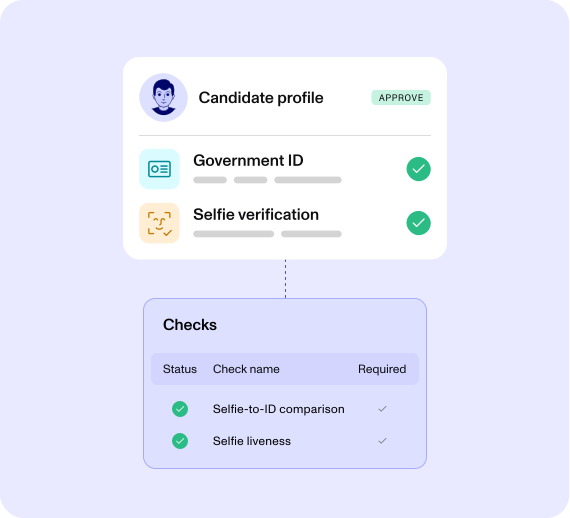
Create one verified identity record
Establish a consistent, verified identity from application through onboarding and employment — complementing background checks and other employment verification processes with an auditable record of trust.
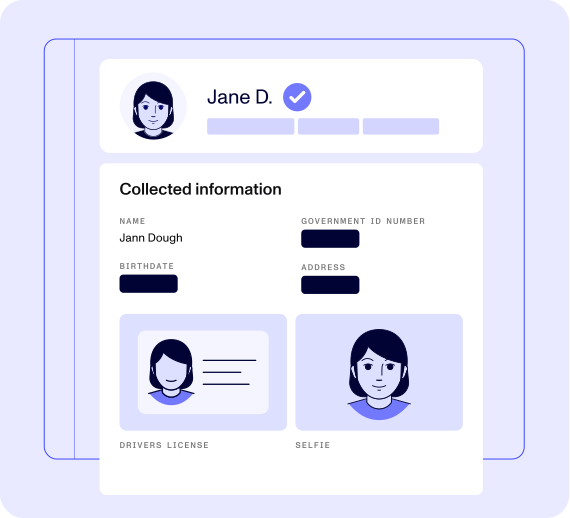
Verify candidates with the tools you already use
Persona integrates directly where you work: inside your ATS and recruiting platforms. Spend less time switching between tools and more time evaluating talent.
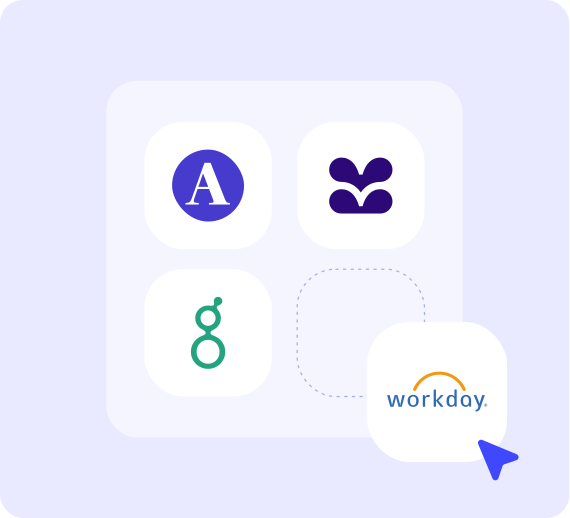
Verify at multiple checkpoints across the candidate life cycle
 Application → Interview
Make sure the candidate you're interviewing is the same person who applied. Detect fake job interviews where bad actors swap in someone else to interview on their behalf.
 Offer
OfferVerify identity in one step before making your offer official. You can also run a final check before your new hire gets laptop credentials, email access, or entry to sensitive systems.
 Onboarding → Employment
Confirm that the person you interviewed and hired is the same person accessing workplace systems and devices.

Platform automation
Integrate Persona with the ATS and recruiting tools your team already uses.
Automatically verify candidates at key hiring stages, like when you schedule an interview or extend an offer.
View pass/fail verification results in one place for faster decision-making and to eliminate switching back and forth between tools.
Unify your identity stack to strengthen your security
Persona integrates seamlessly with your IAM, HRIS, IT, and security tools. Automate identity verification workflows and strengthen access controls without overhauling your existing infrastructure.
Integrations for every touchpoint






Everything you need to stop fake candidates

Collect and verify government ID documents, such as passports and driver licenses, from more than 200 countries and territories.
Fight deepfakes and other types of fraud with selfie liveness checks, video verifications, 2FA device binding, and more.
Leverage device and location signals like IP address, VPN usage, and device fingerprints to detect fraudulent activity or security risks.
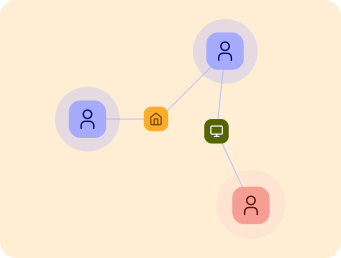
Reveal hidden links between candidate accounts to surface repeat applications and coordinated fraud before they slip through.
Analyze user behavior like unusual copy/paste activity, completion time, and hesitation signs to flag suspicious patterns.
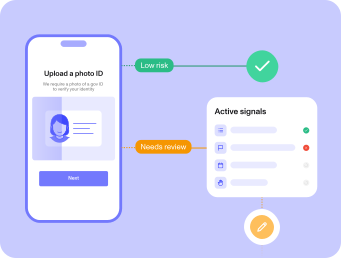
Deliver dynamic employee verifications that adjust friction based on risk level or geography.
Get full visibility into every interaction with rich timelines, audit trails, and detailed context — including geolocation, device information, and verification events — to enable transparent, explainable decisions.
Users receive gesture guidance to minimize user error and provide valuable fraud signals.
Seamlessly embed identity verification into your existing tech stack with native integrations, keeping verification results inside your hiring tools and eliminating context switching.

Use of automated bots to submit mass applications

Outsourcing of interviews or assessments to another person

Use of AI-generated video, audio, or imagery during interviews

Use of stolen personal details, credentials, or online profiles

Misrepresentation of geographic location

Creation of partially or fully fictitious identities
Use of automated bots to submit mass applications
Outsourcing of interviews or assessments to another person
Use of AI-generated video, audio, or imagery during interviews
Use of stolen personal details, credentials, or online profiles
Misrepresentation of geographic location
Creation of partially or fully fictitious identities
With application volume on the rise and a lean talent team, we can’t afford to spend time questioning whether a candidate is real or is who they say they are. Our time belongs in real conversations with hiring teams — and hiring real people.
Leverage Persona’s Know Your Employee (KYE) solution to strengthen workforce security throughout employment. Seamlessly verify employees throughout onboarding, account recovery, and privileged actions.
Frequently asked questions
Toggle description visibility
What is candidate fraud?
Toggle description visibility
Candidate fraud (or hiring fraud) occurs when fake job applicants misrepresent their identity, use stolen credentials, employ deepfakes during interviews, or hide their true location. By 2028, Gartner predicts that one in four candidate profiles will be fake.
The consequences of candidate fraud are severe: it can lead to data breaches (costing companies on average $4.44 million), corporate espionage, regulatory penalties, and employment identity theft.
Which roles or hiring processes do threat actors target?
Toggle description visibility
Threat actors target companies that are hiring remotely or globally, particularly for software engineering, IT, and finance roles with access to sensitive data. Attackers look for hiring processes that rely on self-reported information rather than verified and/or in-person identity checks.
What’s the difference between background checks and identity verification?
Toggle description visibility
Background checks verify a candidate's work history, education, and criminal record. Most employers run them after extending an offer.
Identity verification, on the other hand, confirms the person is who they claim to be during the application and interview stages — before investing time and resources evaluating them.
Background checks and candidate verification are complementary. We recommend companies use candidate verification earlier, then background checks at the offer stage.
How can companies prevent candidate fraud?
Toggle description visibility
The emerging best practice for preventing candidate fraud is through identity verification. When you confirm that candidates are real people, that’s identity verification.
In the past, identity verification was reserved for things like opening financial accounts. Today, identity verification is used across many industries and use cases. It typically relies on a combination of government-issued documents, selfie matching, and liveness detection to verify the person applying is who they claim to be.
Learn more about how identity verification can be applied to hiring and employment in our guide to workforce identity proofing.
Can Persona verify international job candidates?
Toggle description visibility
Yes, Persona supports government ID verification from 200+ countries and territories, with 20+ language options. We offer a privacy-first, GDPR-compliant infrastructure, so that you can tailor candidate verification to local requirements and regulations.
When should identity verification happen in the hiring process?
Toggle description visibility
Every company is different, so the right verification moments depend on your roles, risk levels, and hiring goals. However, we often recommend verifying at three major touchpoints across the recruiting process: at the initial recruiter screening, before the final interview, and at the offer stage. You may continue to verify throughout onboarding.
It’s worth emphasizing that there’s no one-size-fits-all approach, and we work with each customer to determine the right cadence for their hiring process. You can learn more about best practices for candidate verification on our blog.